Trends
Trends
Trends
Ride the tailwind of the industry.
Ride the tailwind of the industry.
Ride the tailwind of the industry.
Q4 vs Q6 vs Q8: A Practical Decision Framework for Local LLM Quantization
Q4 vs Q6 vs Q8: A Practical Decision Framework for Local LLM Quantization
Q4 vs Q6 vs Q8: A Practical Decision Framework for Local LLM Quantization
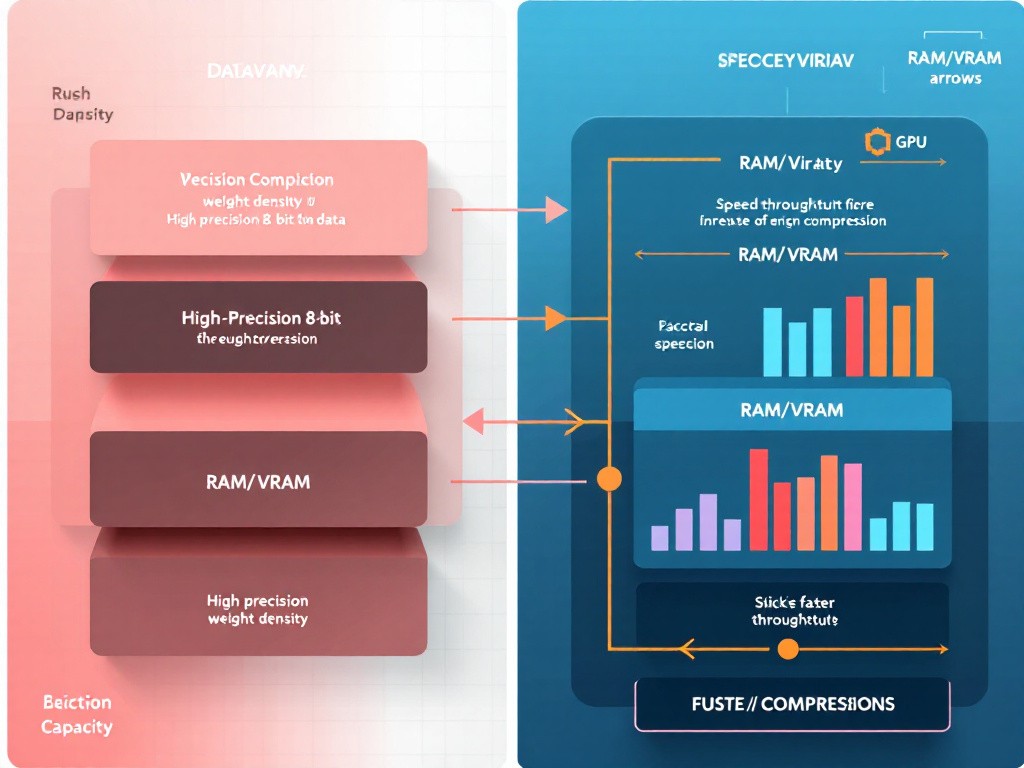
In local LLM deployment, choosing the right quantization level is a critical decision that determines model quality, speed, and hardware requirements. Understanding the differences between Q4, Q6, and Q8—and selecting the optimal level based on task requirements and VRAM capacity—enables practical, production-ready operation.
In local LLM deployment, choosing the right quantization level is a critical decision that determines model quality, speed, and hardware requirements. Understanding the differences between Q4, Q6, and Q8—and selecting the optimal level based on task requirements and VRAM capacity—enables practical, production-ready operation.
As local deployment of large language models becomes mainstream, balancing VRAM constraints with model quality is a critical challenge. Advances in quantization technology have made 4-bit to 8-bit operation feasible, yet many practitioners lack clear criteria for choosing the appropriate level. This article provides concrete guidance on the differences between Q4, Q6, and Q8 quantization and their practical selection criteria.
As local deployment of large language models becomes mainstream, balancing VRAM constraints with model quality is a critical challenge. Advances in quantization technology have made 4-bit to 8-bit operation feasible, yet many practitioners lack clear criteria for choosing the appropriate level. This article provides concrete guidance on the differences between Q4, Q6, and Q8 quantization and their practical selection criteria.
Quantization technology is evolving rapidly, and the figures and benchmark results in this article depend on specific environments, models, and versions. When implementing in actual business operations or handling confidential data, it is highly recommended to check your company's security policies and the latest primary sources, and to conduct benchmark tests in your actual environment. Especially when using overseas models or tools, carefully evaluate data privacy and information leakage risks.
Quantization technology is evolving rapidly, and the figures and benchmark results in this article depend on specific environments, models, and versions. When implementing in actual business operations or handling confidential data, it is highly recommended to check your company's security policies and the latest primary sources, and to conduct benchmark tests in your actual environment. Especially when using overseas models or tools, carefully evaluate data privacy and information leakage risks.
【Benefits of Reading This Article】
【Benefits of Reading This Article】
By reading this article, you will gain a concrete understanding of the performance differences and file size relationships among Q4, Q6, and Q8 quantization levels, the quality degradation patterns for different tasks, and methods for reverse-engineering hardware constraints. This knowledge will improve your decision-making accuracy in local LLM operations and enable you to design configurations that extract maximum performance from limited VRAM environments.
By reading this article, you will gain a concrete understanding of the performance differences and file size relationships among Q4, Q6, and Q8 quantization levels, the quality degradation patterns for different tasks, and methods for reverse-engineering hardware constraints. This knowledge will improve your decision-making accuracy in local LLM operations and enable you to design configurations that extract maximum performance from limited VRAM environments.
FAQ
Reviewed by
Reviewed by

NeoLeverage Editorial Team
We share highlights from our ongoing research and the latest topics shaping the industry.
NeoLeverage Editorial Team
We share highlights from our ongoing research and the latest topics shaping the industry.
Summary
Summary
Revisiting local LLM quantization reinforced my belief that choosing the right level is not about defaulting to the highest precision, but rather reverse-engineering from both hardware and task requirements. The principle that "large model × low-bit" often outperforms "small model × high-bit" is counterintuitive at first glance, making it an easy blind spot. In practice, pushing VRAM to its limit to run a 70B Q4 is frequently a smarter choice than comfortably running a 13B Q8. This shift in perspective often determines the success or failure of local deployments.
Revisiting local LLM quantization reinforced my belief that choosing the right level is not about defaulting to the highest precision, but rather reverse-engineering from both hardware and task requirements. The principle that "large model × low-bit" often outperforms "small model × high-bit" is counterintuitive at first glance, making it an easy blind spot. In practice, pushing VRAM to its limit to run a 70B Q4 is frequently a smarter choice than comfortably running a 13B Q8. This shift in perspective often determines the success or failure of local deployments.
Search
Popular Articles
Popular Articles
Google Ads Strategy to Capture Gen Z—New Rules for the Social Media Era
Metalab's Design Philosophy Behind Slack & Uber—Balancing Tactile Experience and Revenue
Remote Control of Claude Code from Smartphones: Real-World Implementation Review
AI Development Race Intensifies: How DeepSeek's Emergence is Reshaping Enterprise Selection Criteria
AI Coding Tools Market: The Intensifying Share War and New Selection Criteria
Figma Adds AI Motion Graphics and Code Layers: The Line Between Design and Code Blurs
WordPress 7.0 Delayed to Prioritize Real-Time Collaboration Stability
Genspark Unveils AI Workspace 4.0 with Desktop and Office Integration
Who Really Owns Enterprise SEO? The Accountability Gap Killing Performance
LLMO, GEO, AIO Explained: Why Terminology Matters Less Than Implementation in AI Search Optimization
Latest Articles
Latest Articles
5 Essential WordPress Development Tools to Accelerate Your Workflow in 2026
Google's Next-Gen Search Model: Replacing Two-Stage Ranking with a Single AI
ChatGPT Shopping Results Now Dominated by Product Feed Integration
ChatGPT Now Controls Website Features Directly: How WebMCP Support Changes AI Interactions
The Real Sources Behind AI Search Citations: Why Every Industry Needs a Different Strategy
Recommended Articles



Recommended Articles
Recommended Articles

順風満帆。帆を張れ、追い風だ。
© 2025 NeoLeverage Inc.
順風満帆。帆を張れ、追い風だ。
© 2025 NeoLeverage Inc.
順風満帆。帆を張れ、追い風だ。
© 2025 NeoLeverage Inc.
